

Restoring Our Communities: Reflecting on the Quality of Our Relationships
This week, we're bringing you news about our storytellers, reflections on restorative community gatherings, and recommendations for what to watch, read and listen to.

NEWS: Jacob Dunne Named Expert Adviser on Restorative Justice
We're delighted to share that one of our storytellers, Jacob Dunne, has been appointed as as Expert Adviser on Restorative Justice for the UK Government.
Here, Jacob reflects on his appointment as a voluntary government advocate for the next 18 months:
“I’m incredibly grateful for this opportunity and excited to get to work. For too long, people with lived experience of crime and the justice system have been talked about rather than listened to. Yet some of the most valuable insights about how to reduce crime, support victims, hold people accountable and create safer communities come from those who have lived through these experiences first hand. […]
I’m looking forward to working with the Minister and colleagues across the sector to champion Restorative Justice, amplify what works, and help ensure that both lived experience and common ground have a place at the heart of shaping the future of justice.”
You can read more about Jacob’s appointment in coverage from BBC News or The Guardian.
How Artificial Intelligence Sees The Forgiveness Project
As a fun experiment we recently asked AI to create a graphic out of the following statement: "TFP (The Forgiveness Project) is an organisation that works with the real stories of people who have been harmed (and people who have harmed others) with the purpose of shining a light on what it takes to heal, restore or find peaceful resolution." This is what it came up with.
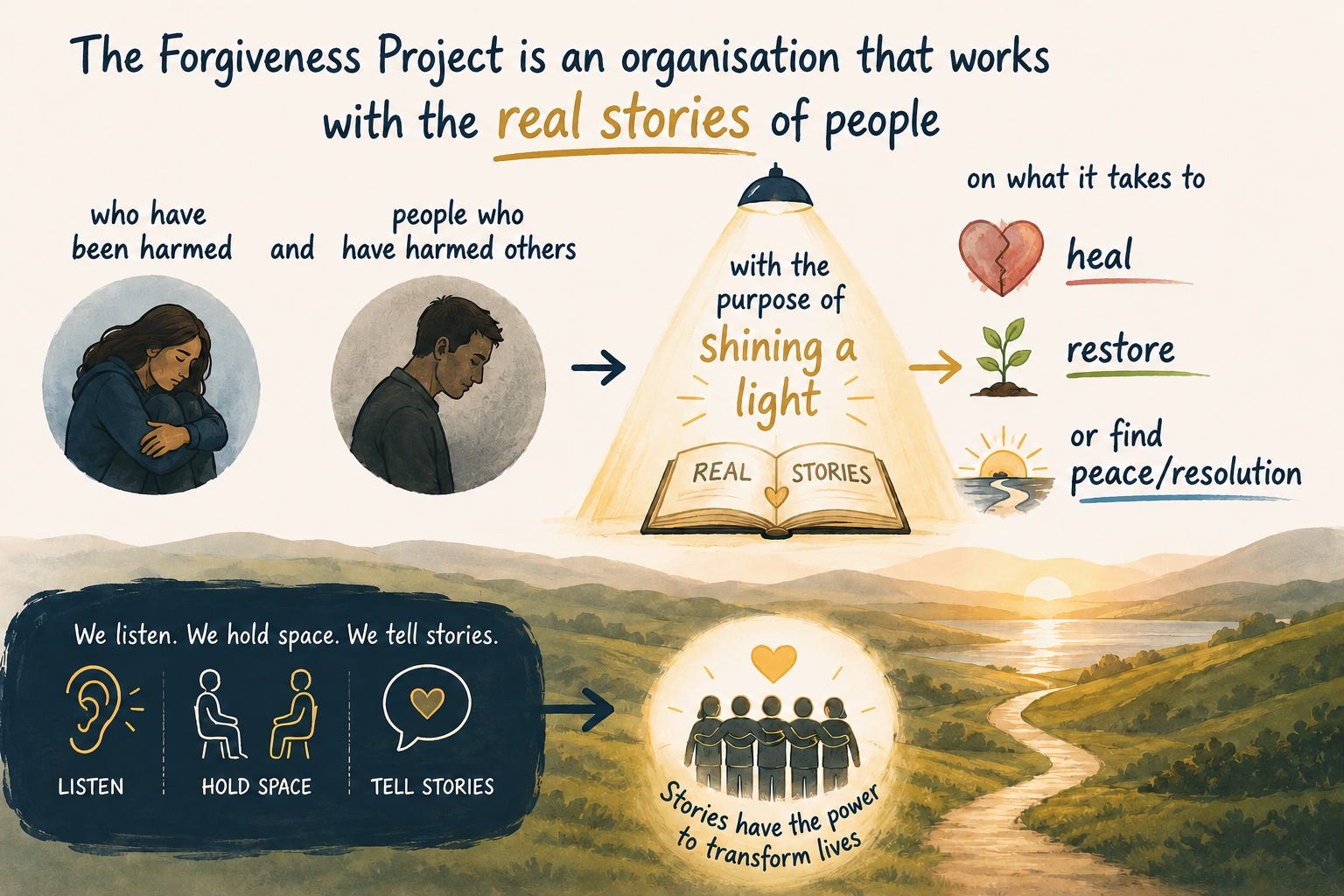
Over the years, our charity has inspired a wide range of creative responses to our work and the real-life stories of forgiveness we share. We'd love to see your own doodles, illustrations, and creative interpretations of The Forgiveness Project. If you'd like to contribute, please send your creations to info@theforgivenessproject.com.
In Reflection: Community Events for Young Men and Parents
Here, Sandra Barefoot, Executive Director of The Forgiveness Project, reflects on our latest in-person community events in the UK.
“As we continue this year our explorations of Forgiveness Café spaces in partnership with extraordinary community leaders, Joanna Atogdina and Muna Ali of Westway Trust in North Kensington, serving communities affected by Grenfell Tower, I am humbly reminded that these spaces we hold are only possible because of the quality of our relationships.
I believe it is the quality of relationships to ourselves and others that is the most vital ingredient that allows trust, vulnerability, safety and transformation to be possible.
Our Community Café in April, in partnership with Baraka and Beyond the Narrative, brought together 18 young men.
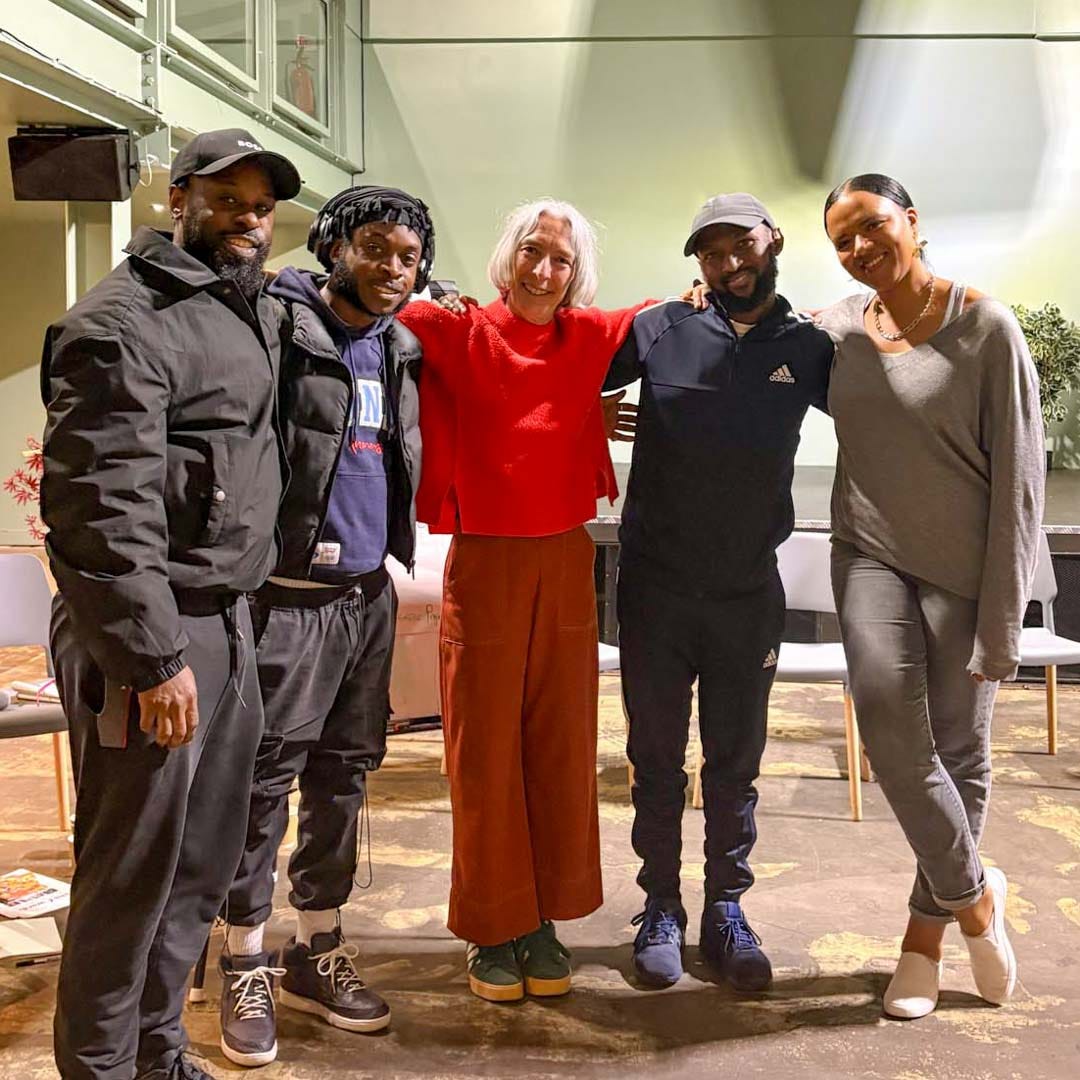
Youth Justice Advocate Aaron Anthony, Trauma Informed Practitioner Bob Mugisha, and Beyond the Narrative founder Javel Watt supported the space through the powerful use of spoken word.
Poem by Aaron Anthony
Nah not even, no procrastination,
Grateful for what we have that’s motivation,
Started winning when you have a heart of appreciation,
When you have self-worth, you don’t need to live up to a reputation,
I learnt Accountability is how we manage anger,
Care and courage kept me, experience is an anchor,
Don’t carry a weapon how many man have died cos of pride,
Imposter syndrome is your mindset greatest lie,
Being black in ends,
All the things we suppressed,
When you know who you truly are, you’re not easily vexed,
Anger management, pain and hatred is damaging,
Common Story, they were once good youths now they’re savages,
I was sitting down reflecting,
I’m responsible to make sure I don’t kill my own reflection.
In May we held two further cafés for parents and for young boys. The Parents' Café gathered over 35 people from a wide section of the community. The group considered the struggles of parenting whilst listening to storytellers Raushia Coles and Jacob Dunne reflecting on their own learnings as parents.


‘Am I doing it right?’ asked many participants. Some traced where fear and trepidation lay for them, while others spoke of a place of hope, light, patience and care, and the knowledge that there were others to support what one person described as a very ‘lonely’ place.
I was particularly struck by this one image shared of a mother who said: “There is a wall between us. Over the wall I am trying to touch the heart of my son - I am grateful I still have a relationship.”
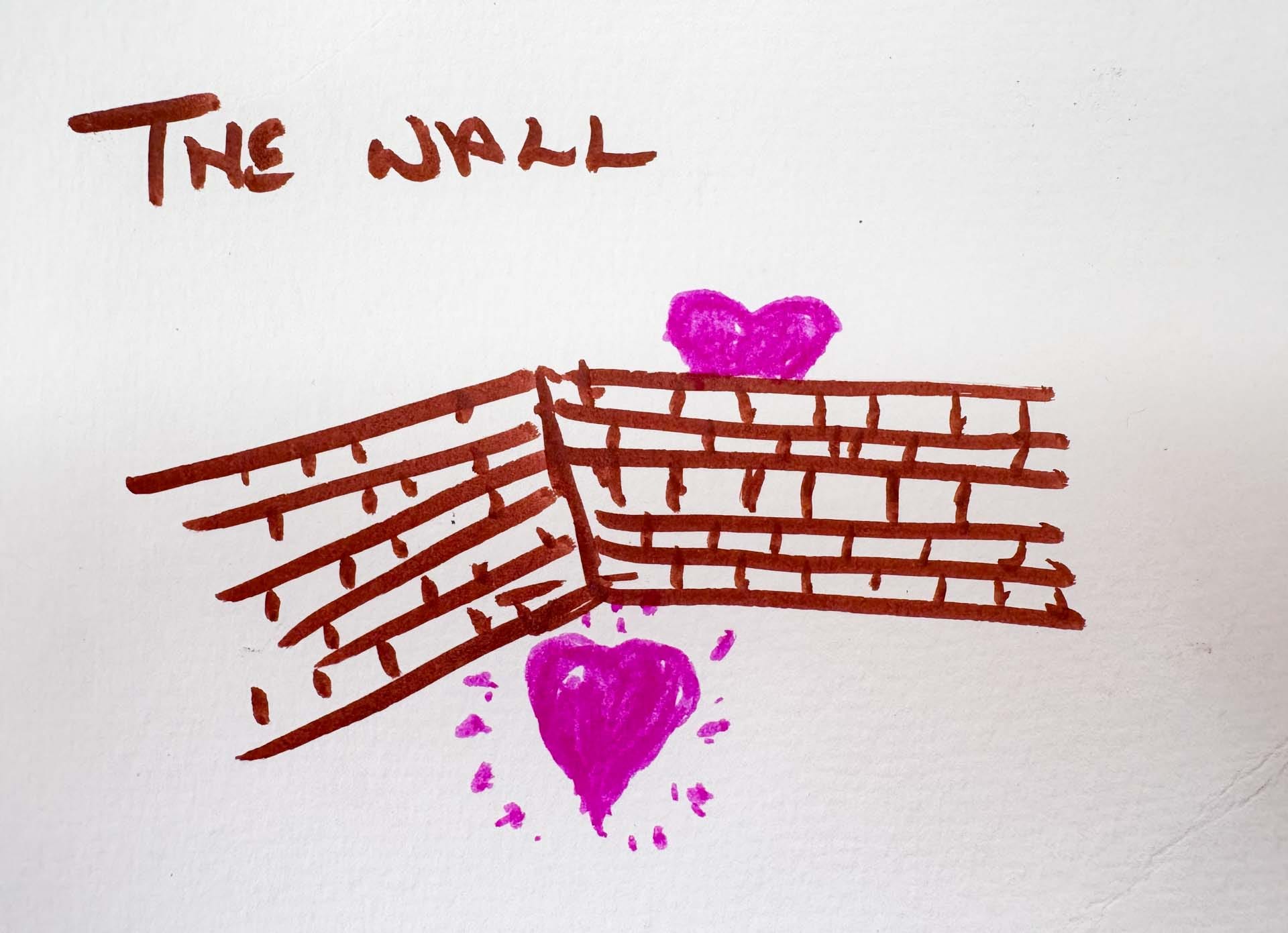
“The Safe Space curated was necessary for healing, learning and evolving to take place but it doesn’t happen overnight. I am hopeful that these circles will spark conversations around community, identity and communication which should serve as gateways to forgiveness in its many forms.” - Bob Mugisha
Javel Watt left the café being reminded that:
“…healing does not always happen through big dramatic breakthroughs.
Sometimes it happens in a conversation.
In a challenge.
In a line of poetry.
In a room where young men feel safe enough to reflect.
Thank you again, Sandra, for inviting us into the space.
This is what community work should feel like.
Human.
Honest.
Creative.
Reflective.
Real.”
I feel honored and grateful to be developing and deepening our work with extraordinary leaders and collaborations and look forward to sharing further work with you in the future.”
What We’re Watching, Reading, and Listening To
TV: Tip Toe by Russell T Davies
Founder, Marina’s recommendation:
“I almost hesitate to recommend Russell T Davies’s chilling new drama for Channel 4 Tip Toe. If you’re someone like me who longs for a world where kindness, curiosity and respect are valued and not mocked, then this will be a very hard but important watch.
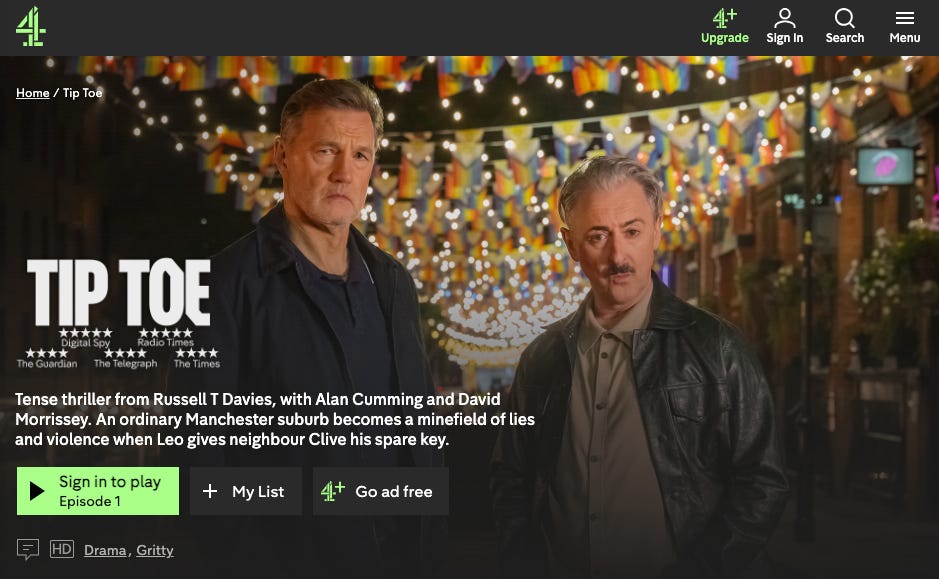
It’s the story of two neighbours and how prejudice leads to horrifying mob violence. It illustrates how being unkind is too often seen as courageous, while being kind is treated with suspicion; how hostility towards marginalised groups is too often praised as authenticity, while empathy is dismissed as virtue signalling.
There is nothing hopeful in this story, except perhaps that the show has garnered such huge support from fans and followers – all of whom believe everyone deserves the same respect, dignity and freedom to be themselves.”
BOOK: East of Eden by John Steinbeck
Our Administrator, Georgia, recommends John Steinbeck’s 1952 family saga as one of the “most compelling” explorations of identity, generational harm, and the relationship between good and evil.
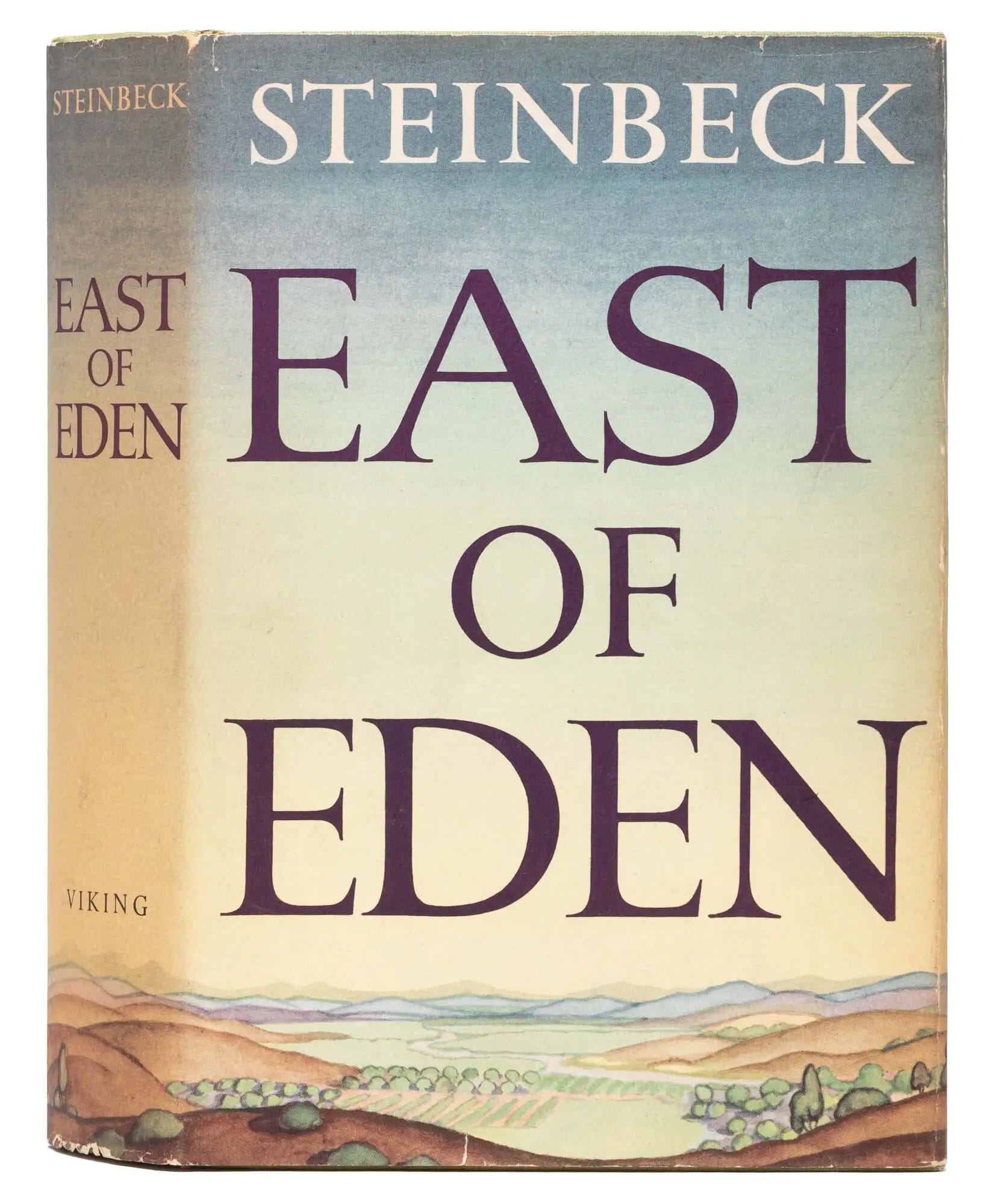
The story is set in the rich farmland of California’s Salinas Valley, and follows the intertwined fates of two families – the Trasks and the Hamiltons – over three generations, observing how their members re-enact the vicious rivalry of Cain and Abel and the dramatic downfall of Adam and Eve.
Georgia writes; “for me, this story is a truly captivating account of the cycle of familial harm, internal conflict, and the themes of right and wrong, all of which Steinbeck masterfully reflects in his descriptions of nature in the beautiful yet challenging location of Salinas.
The plot submits itself to the simplicity of myth, and the reader is captivated by the complexities of the novel’s many characters: admittedly, I find his portrayal of some of the women in the text to be flat, passive or even caricatural, serving more so as vehicles for the exploration of men, but Steinbeck does present some intriguing characters who are at once well-meaning but reserved, calculated yet vulnerable and intelligent albeit reactionary.
To me, the author makes abundantly clear his commentary on the prevailing harm of inter-familial pain and desire for love and recognition, as well as a convincing portrayal of freedom of choice and its consequences. Indeed, the core philosophy of the text “timshel”, a Hebrew word meaning “thou mayest”, which to me represents Steinbeck’s central argument that people are not destined for good or evil but are rather defined by circumstance and possess choice in their every action.
The conclusion also left me with many thoughts; here “timshel” is employed as the final spoken word of the book, in an almost redemptive manner. I wondered here whether Steinbeck was suggesting that forgiveness, love and acknowledgement from another is enough to free us from the spiral of shame and harm.”
“And now that you don’t have to be perfect, you can be good.” – East of Eden
PODCAST: The Curiosity Shop with Brené Brown and Adam Grant
Our Communications Manager, Katalin, recommends Episode 6: The Emotion Few Talk About, But Many Feel from The Curiosity Shop.

“From classrooms and locker rooms to workplaces and social media, Adam and Brené trace how shame and humiliation are used to control behavior and even fuel violence. They explore what causes shame, why our self-protective responses backfire, and how we can handle it more effectively. They also unpack the messy overlap between imposter syndrome and cultural pressures toward self-doubt.”
“To be alive, you know it. Everyone's got it. No one wants to talk about it. The less you talk about it, the more you have it.” - Brené Brown